






A billion years ago at a party, when I was young and had hope to burn, I said that I “didn’t believe” in entropy. I was speaking kind of poetically, in a “rage against the dying of the light” kind of way, but my friends were of a scientific bent and were offended by what they saw as a denial of reality.
A few weeks ago, at a party, 1,000 miles and many years away from the first, a scientific researcher told me in passing that the “only thing he believes in” is entropy.
Sometimes my life rhymes in a fun way.
I’ve been thinking a lot about entropy lately—can’t imagine why—and because I’m me, I found myself thinking about it in relation to recent pop culture. Something that struck me over the last few months is that our current Superhero Industrial Complex is living or dying based on how they approach entropy. And since I saw Fantastic Four: First Steps, I’ve been turning it over in my brain and comparing it with its most direct summer blockbuster competition, Superman, and its immediate Marvel predecessor, Thunderbolts.
I hate to begin with a negative, but Fantastic Four really did not work for me. I loved the jetpunk aesthetic, I love Pedro Pascal, Cousin Richie is my favorite part of The Bear, I thought the way they used H.E.R.B.I.E. was perfect—and yet I left the theater disappointed and rewriting the movie in my head. I’ve been mulling the reason why, and ultimately I think Superman and Thunderbolts work so much better for me because they’re the first superhero movies in years that engage with life as it is right now, entropy and all. This was thrown into relief by the extent to which Fantastic Four felt like a relic of a past era.
Thunderbolts is about depression. It’s about finding meaning in life. Superman is about standing up to oppression. It’s about standing up to sociopathic tech billionaires who want to control the lives of everyone poorer than them—i.e., everyone. Fantastic Four is about a family of superhero astronauts who seem to rule over their entire planet (benevolently, but still) and refuse to give their superbaby to a planet-eating alien.
And it just feels so far from life as many of us are living it that it tips from being escapist into insulting.

Thunderbolts deals with the utter exhaustion everyone I know feels right now.
The tone of this film is much less the old Marvel of “We, the group of super special super people, will save the day! We’re colorful and fun, not like those dour guys over at DC! The future is bright, baby!” and much more a response to 2025: “We’re exhausted and sad and completely outmatched. We kind of helped popularize the guy who destroyed your grandma’s retirement? Sorry about that. But we’re going to try to be heroes just for one day, because today is all we have.”
It does what Marvel used to be best at—taking recognizable problems and joys from ordinary life, and asking what it would be like to experience them with the added complication of superpowers.
Yelena’s a depressive alcoholic, Bob is a depressive addict-in-recovery, Red Guardian is miserable that he’s not an active superhero, John Walker’s the most divorced anyone’s ever been, Bucky’s flailing in his new political gig, and Ghost is—well, she actually seems to be doing better than the last time we saw her, but she’s still a merc for hire. They’re freelancers, gig workers, divorced dads, addicts in various levels of recovery, Congresspeople. Not an inspiring bunch, perhaps, but a perfect reflection of the U.S. in 2025, when most of us cobble multiple jobs together, a lot of us are still reeling from the pandemic, a lot of us (insert significant cough here) are reeling from however we medicated to get through the pandemic. And a lot of us are either seeking public office, or supporting people who are, in the desperate hope it might slow the spiral we’re in.
The movie also acts as an up-to-the-minute 2025 reply to The Avengers. Not in a cynical way, but in a way that reflects where the country is now, as opposed to where it was in 2012. The Avengers were a team of powerful people: a couple of highly trained spies, a ludicrously pure-hearted supersoldier, a genius scientist who occasionally turned into a green rage monster, a literal god, and a second genius scientist who feels human compassion despite being a billionaire (his true superpower, and sadly unique). The Thunderbolts take each of these characters and subverts them. We still have two highly trained spies, but now one is clinically depressed and mourning her sister, and the other deals with chronic pain. We have not one but three supersoldiers—except one is a somewhat washed-up Soviet knockoff of the American original, one is filled with rage and PTSD, and the third is Bucky. Finally there’s another literal god, who is technically stronger than the other one… except he turns into A VORTEX OF DEPRESSION MONSTER THAT DESTROYS ALL IT TOUCHES if he activates his god powers.
When Sentry becomes Void it still takes people a while to notice him floating up there. (This is accurate in my experience of NYC; most people don’t look up very often.) This is the worst villain who’s ever threatened them, but they don’t know that, and it takes long moments before his threat becomes apparent. When he Voids people they become flat black shadows on the pavement. The cops aren’t there to help—they’d be instantly Voided too. So would Nick Fury, for that matter, but he’s not there to call in any shadowy council. There are no aliens presenting a threat from outside—this is a purely homegrown catastrophe, created by the U.S. government, and the only people who know what’s going on are C-grade mercenaries.

When the Thunderbolts spring into action to help—because they do—it’s clearly an effort. This isn’t Cap striding around yelling at the NYPD and saving a whole Grand Central Terminal’s worth of people, or Tony flying around in his impossibly cool mecha. It’s Red Guardian saving a little girl by catching a slab of concrete on his back. It’s Bucky barely, barely stopping a falling helicopter with the arm that was ripped out of the socket only moments before. This is, to quote another Marvel mercenary, maximum effort.
And then the girl Red Guardian saved is turned into a black shadow as he holds her hand.
It’s shocking in its suddenness, its seeming permanence, its mercilessness.
People are Voided as they run screaming. People flee into buildings, but we know that doesn’t protect them. Everyone in Manhattan is Voided by the end. That’s probably 5 million people, with who knows how many shame rooms. (Whatever number you’re thinking right now, remember Matt Murdock lives in Manhattan and TRIPLE THAT.) On the plus side, no one’s trying to nuke New York City, but on the other hand it doesn’t matter because New York City is already effectively dead, and in hell.
The Void flows over the city, silent, implacable, like the Nothing in The Neverending Story. There’s nothing there to reason with, or beg for mercy, or fight. This is the dark side of Sentry, who has every possible power and seemingly no weaknesses. The Void is a perfect antagonist for the world Thunderbolts creates. It’s a culminating event, a natural conclusion, and the film never for a second ignores how terrifying he is. The first thing we see him do is erase a frightened little girl from existence—not one of the superheroes, not Valentina, no, a child who has no idea what’s going on. The world of the film is chaos, and every detail adds to that.
Fantastic Four created a vibrant and interesting alternate universe and then declined to show us most of it. Rather than focus on, say, a few smaller villains, so we could see Marvel’s First Family working together as a team, the filmmakers immediately throw us into the extinction-level-event of Galactus’ arrival. But even here, I feel the film doesn’t commit to the terrifying reality of Galactus. How much stronger would the movie’s second act have been, as we watched the Richards convince the world to join together against an existential threat, only for it to fail at the last moment?
And please understand, I’m not saying I wanted a dark ‘n’ gritty Fantastic Four! We already got that movie in 2015, and I didn’t like it very much. I just wanted to know a bit more about this alternate universe, and to feel invested in more than just the Richards family and their dynamic.

As it is, Galactus’ threat feels impossible, and the movie doesn’t do nearly enough to bring it home. We watch the Four confront him in space, but as far as regular people? Every human on the planet is dealing with the idea that they might all die—not at some fuzzy point in the future, of an accident, or illness, or old age, but in a couple months, violently, because an alien is going to murder them. Every single human on Earth has received a death sentence. And they’re going to know each day that he’s creeping closer, and there’s nothing they can do about it. That would create a hell of a lot more desperation that the film wants to show us—especially in a world where people have become accustomed to a family of superpeople saving them!
The movie doesn’t show us any of that drama. We see Lynne Nichols (Sarah Niles) watch the Fantastic Four on television, we see journalists at press conferences, we see people yelling insults at Ben, and we hear the distant shouts of a mob, many many storeys below the Four in their tower. When we finally see the mob, they’re easily calmed by Sue quoting the Fast and Furious franchise. (I don’t know what kind of mobs these writers have witnessed, but we’ve clearly lived very different lives.) At no point do we check in with the kids who used to chant Ben’s name as he walked down the street, or any of Johnny’s exes, or, I don’t know, a dentist in Latveria, or anyone who might show us how regular people are coping with this terror. Ben goes back to the Old Neighborhood and walks into Temple for half a second, but is he stopping in because he might die the next day? No, he’s only going to get a date with Natasha Lyonne! Which, to be fair, is also my End Times Plan—but even here, rather than getting a quiet scene between the two of them talking about their impending doom, or lamenting that he’s taken this long to visit her, no, we have to rush through this small human moment to get to the big CGI battle.
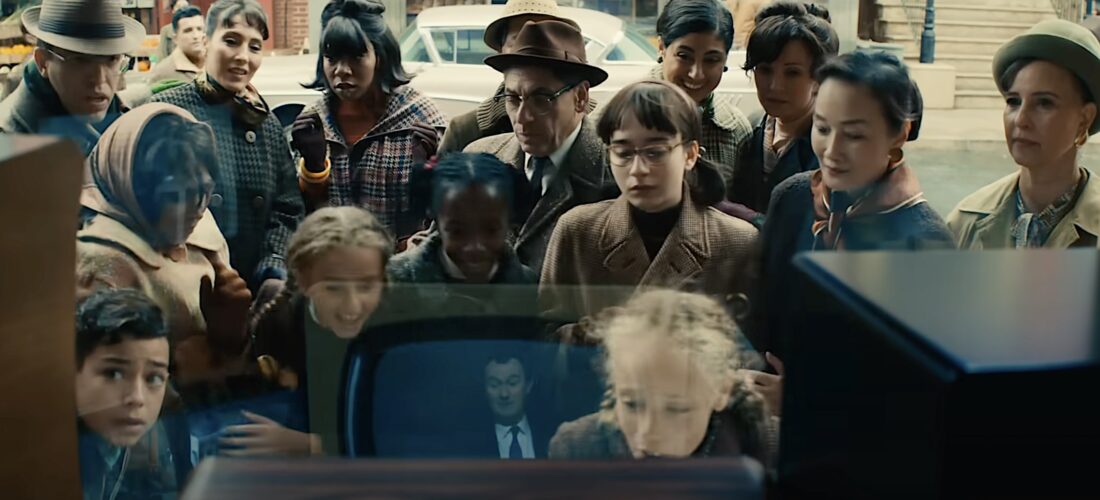
Even speaking purely of practicality, First Steps raises the idea of the teleportation portals, and, further, the fact that it will take a ton of cooperation and energy to make them work. But then it doesn’t show any of that cooperation—just the Four on the phone with various world leaders. Everyone agrees to turn the lights off every night, with no word about how that actually works. We could have had a montage of people working night shifts, hospitals turning on back-up generators, people patrolling the streets to remind people to turn their lights off like we did as air raid precautions during World War II in our own timeline—details that would have made it feel real. When we finally see an evacuation, it’s the citizens of New York going underground to Harvey Elder’s Subterranea—as though that wouldn’t be the worst fucking place to hide when Galactus stomps through the City. You’ve had months to plan this, Sue. Maybe send them up to your universe’s equivalent of the Hudson River Valley, at least?
Compare this with Superman! We check in constantly with the people (and dogs, and squirrels) of Metropolis. While fighting a kaiju, Superman takes the time to check in with people in the nearby building to make sure everyone’s all right. When Luthor’s reality rift threatens the city, we see people load kids and pets into cars, a woman tries to drive over a bridge until her car stalls out, an older woman queues up to board a bus with her pet turtle in a terrarium. This is Metropolis, they’re used to kaiju and occasional interdimensional imps, so they don’t panic—but this is a bigger threat, and the city takes organizing an escape seriously, and Gunn makes a point to check in with them so we see the real human impact of Luthor’s shittiness.
The movie doesn’t even show us the big Inciting Incident battle that gets our hero into trouble. We don’t see him stop Boravia’s invasion of Jarhanpur, and we don’t see the first losing battle with The Hammer of Boravia. What we get instead is an assessment of the damage he’s taken, introductions to Krypto and the Superman robots, and then a ten-minute-long scene of Lois interviewing him about those battles. We see the aftermath, the physical and emotional cost of his life as a superhero.
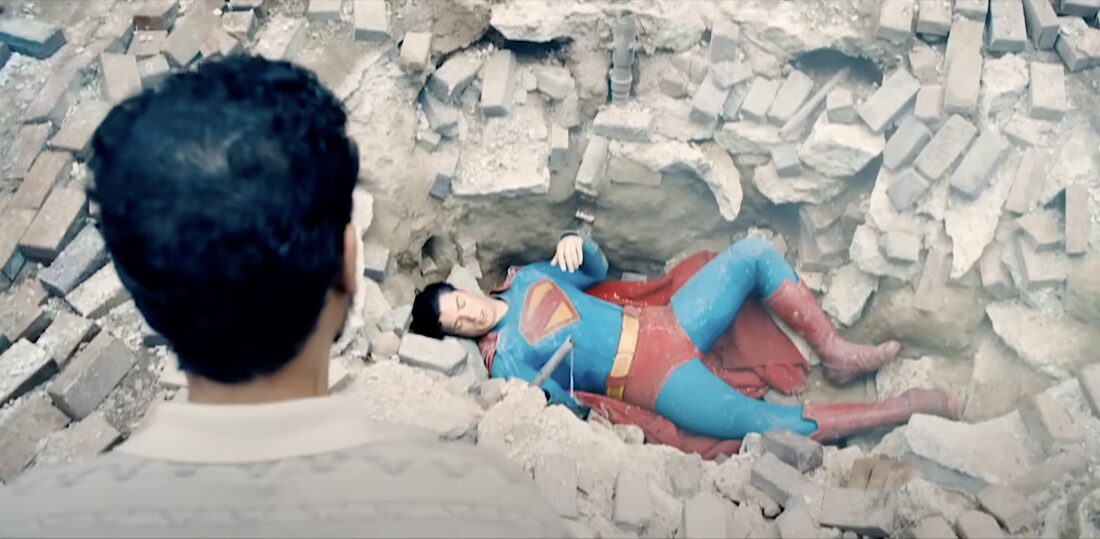
Superman chooses its villains to deal directly with life as it is now in our universe. We’re stuck with a handful of tech billionaires who have decided that they, and only they, know what’s best for humanity, and they have too much money for anyone to stop them. (At least one of them even banked on people thinking he was “the smartest man in the world” for a bit—as though buying into the idea of there being a “smartest man in the world” doesn’t immediately disqualify the buyer from the ranks of the intelligent.) We’re stuck with world leaders who don’t give a shit about human life. In the film’s big action plot point, Superman intervenes in a war that has parallels to a few different invasions and attempted genocides over the last few years, each of which have been politicized in the same disgusting way the war is politicized in the film.
I’m not a theologian or a moral philosopher or even a particularly good person, but I do know that it’s bad when children starve to death. It’s bad when hospitals full of sick people get blown up. The context doesn’t matter.
Part of the genius of the film is that Gunn sets this up, and gives Lois perfectly reasonable questions and concerns—but Superman cuts through all the noise with his statement that people were going to die.
Which, yeah.
I love that the movie does give voice to the nuances and complexities of geopolitics, but I love far more that it gives Superman a moment to call bullshit on all of it. All the jokes and playfulness and references and meta humor drop away in the moment. Boravia’s invasion of Jarhanpur is very clearly a strong military with foreign backing invading and oppressing another country that is weaker, and does not have funding from outside. Well-armed people are about to murder people who can’t defend themselves. End their lives, their consciousnesses, make it so the last thing they’re aware of on this earth is agonizing pain.
There is no justification for that.
There just isn’t. There is nothing, nothing, that outweighs a human life.
Or, to use Nobel Prize-winner László Krasznahorkai’s words: “Only the ordinary person exists. And they are sacred.”
And I think the thing a lot of people are responding to is that Superman just fucking says that, and then every single thing he does makes that belief physical in the world. He doesn’t want to kill the kaiju. He wouldn’t have dropped the President of Boravia from a great height. He doesn’t want to kill the Engineer; even as she chokes the life out of him, he just wants her to let go of him.
But see, that’s where the two strongest superhero movies of the last few years really shine: when they’re dealing with death.
Marvel movies are full of sacrifice plays. Technically half the Marvel roster has died and come back multiple times, sacrificing themselves for each other like it’s a hobby. One of the best moments in the whole MCU is when Steve Rogers throws himself on a grenade before he realizes it’s a dud. Later, his first solo film ends when he crashes a plane into the Arctic to save New York. Natasha battles Clint for the opportunity to sacrifice herself like they’re fighting over the last slice of pizza in the box. Groot kills himself to save the other Guardians, Peter quill throws himself into near-certain death a couple times, and Rocket dies at least once. Tony “I’d cut the wire” Stark carries a missile into a wormhole knowing he probably won’t make it back, and later sacrifices himself to defeat Thanos in Endgame.
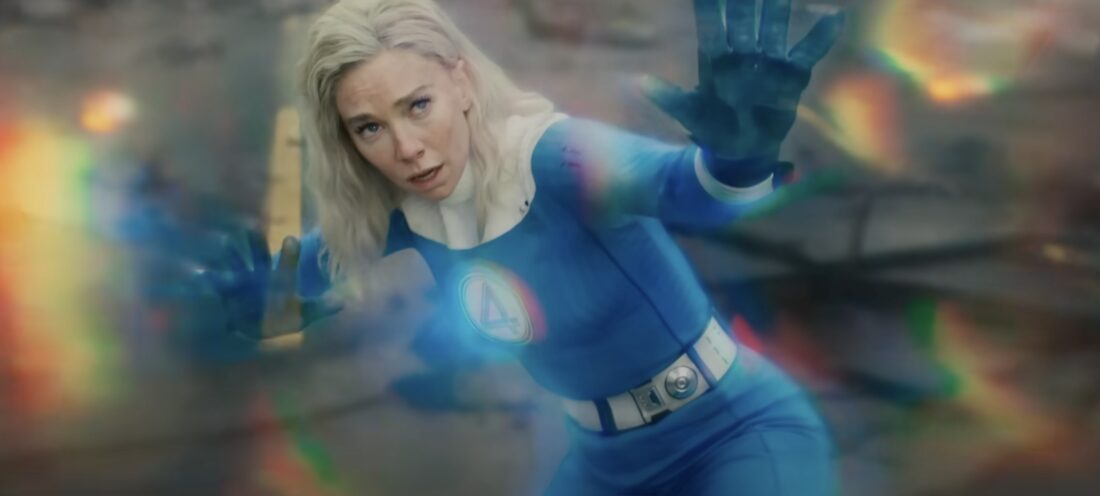
In Fantastic Four, the obvious sacrifice would be trading Franklin for the safety of Earth. This option is barely even discussed, and Sue acts like Reed is a monster for even considering to consider it. Personally I think it would have been interesting to go that route and have them talk it through. Instead, the sacrifices that are made are all by Noble Moms. We learn that the Silver Surfer gave her life to Galactus to save her planet—but really to save her child—and despite the fact that the Richards family is also endangering the safety of others for their child, the Surfer’s initial sacrifice is presented as a moral failing. Then Sue sacrifices herself, dying from the effort of pushing Galactus through the portal, but the Surfer is not going to be out-Noble-Mommed, and re-sacrifices herself by giving her boss a final shove, even though it means going with him. This second sacrifice is overshadowed by Sue’s death, but then Sue’s sacrifice is also rendered meaningless when Franklin pulls a Superpowered Uno Reverse card and resurrects his mom… somehow.
There’s no discussion of trying to rescue the Surfer (even though she’s the one who saved them all in the end?) and, in the typical way of Marvel, all of the thorny emotions of this ending are shoved aside so they can get to Dr. Doom and tease the next movie. While each member of the family use their talents and powers to protect family, it comes down to the two moms to make the sacrifice play and risk everything to save the baby and the world. I think the movie makes it clear that this is why it worked, especially since it immediately tees up another threat against Franklin.
In Thunderbolts, the big “sacrifice play” moments are coded as suicide attempts. When Bob stands up in front of a literal firing squad, is he “just” trying to create a diversion, or is he hoping the bullets kill him, or is he hoping to finally be important in his own mind? The movie leaves his motivations ambivalent. When Yelena walks into the void to get Bob, it’s also played as the culmination of her earlier suicidal ideation—that’s certainly how Red Guardian sees it, and his screams of grief are real. She doesn’t know what’s gonna happen when she allows the Void to swallow her. She might just… die, right? Or be trapped in whatever it was forever? While she seems to suspect that she’ll be able to find Bob and pull him out of himself, as it were, she can’t know. And she’s shocked when her father and new friends come in to rescue both of them. Even tough she was willing to risk herself for Bob, the idea that others might do that for her is unimaginable.
And then, to come back to Superman, there’s Malik Ali.
In Richard Donner’s Superman: The Movie, our hero is humanized by Jonathan Kent’s death from a heart attack. For all his strength, Clark can’t bring his father back from the dead, and that loss tempers his growing power. In Zack Snyder’s Man of Steel, Jonathan Kent asks Clark not to save him from a tornado so he can keep his powers hidden. I personally hate that scene, but still, it ties Clark’s humanism to his grief over the death of his father.
Gunn goes in a different direction, one that I love.
Superman has been public for three years. He lost a fight for the first time a couple days ago, but he lost knowing that he could heal himself with a quick trip to the Fortress of Solitude. When he’s faced with a death he can’t prevent, it’s a very different situation.
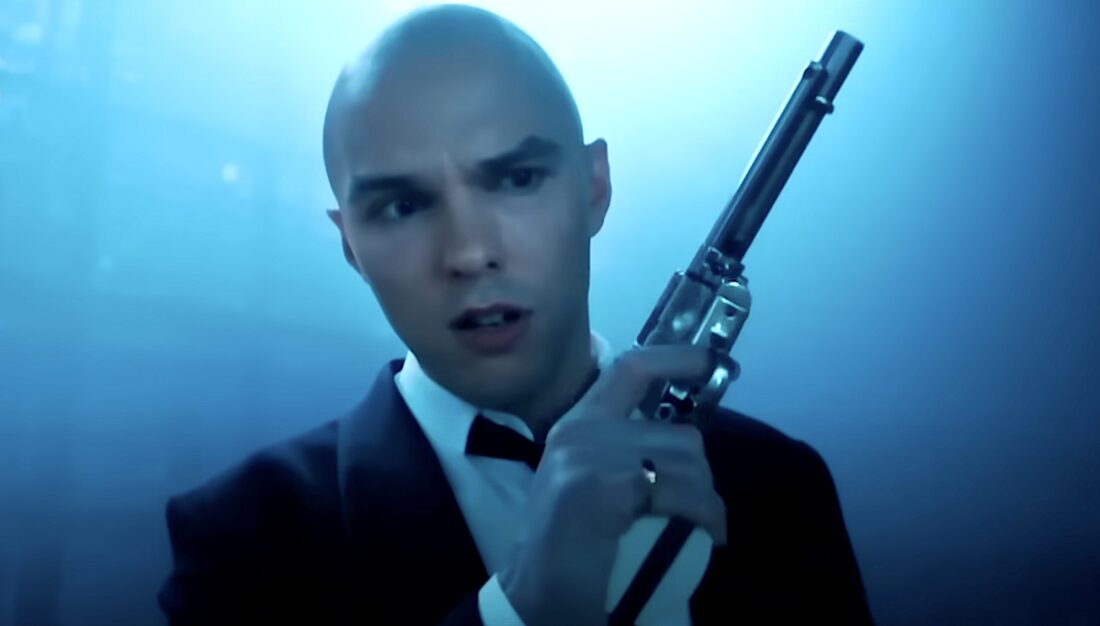
Luthor drags Malik Ali in, forces the man to kneel outside of Superman’s cell, and holds a very real, very loaded, gun to his head. Malik doesn’t plead for his life, or speak against Superman, but instead repeatedly tells Superman not to give in. Even after Luthor pulls the trigger the first time. Even seeing that Superman has been rendered helpless. Superman, powerless, does what any regular Earthly human would do: He begs Lex not to shoot Malik, then screams and sobs when he pulls the trigger a second time, and shoots Malik in the head.
But it’s not just him. Metamorpho is being coerced by a threat against his child, just as the Silver Surfer was. He’s a victim here, too, weeping and panicking as he realizes that Lex really did point-blank shoot a man, in cold blood, with no remorse—and that he, a Metahuman with powers and abilities beyond those of a normal person, just sat there and let it happen. When he rallies and works to heal Superman, the film does something that still, weeks later, makes me flail like a Muppet when I think about it: The two prisoners on either side of Superman’s cell try to rat Metamorpho out. One yells at them to stop before they get everyone in trouble, then both yell for the guards, but one yells at the other that they better not try to take credit for calling the guards. So it’s not just that they’re complicit rats—they want to get brownie points for being complicit rats.
However, at the end of the film, as all Lex’s prisoners are freed, we see that wannabe-rat ex-girlfriend, still in the floofy pink club fit she must have been wearing when Lex kidnapped her and locked her up, run sobbing into the arms of her waiting parents. She was a rat—but she was also terrified. She was a rat—but she’s still a person. She has a family who loves her, who have been frantic since she disappeared, and presumably couldn’t get her back even if they knew where she was, because the government allowed Luthor to act above the law.
Compare this with Fantastic Four‘s treatment of Silver Surfer. We see a gauzy Vaseline-lens flashback of her life on her planet, walking with an unnamed child who I assume is hers. We see her rise to join Galactus, and we see him enrobe her in silver. We finally know, after so much suspense, that the board is NOT part of her body. (Whew!) We know that she’s complicit, that she doesn’t want to be, that she only did it to save her own planet. We see her stand up to Galactus for about a millisecond before he causes her some sort of nebulous pain, and she submits to him again. We see her destroy all the portals on Earth to prepare for Galactus’ arrive. (Except New York City’s, for plot reasons.) And we see Johnny confront her with her own Tragic Origin Story (that he’s somehow worked out from the tiny scraps of her language he’s been able to collect). Seeing her Tragic Origin Story seems to change her mind (after how many decades and devoured planets?) She swoops in at the very end to push Galactus through the one remaining portal, but she also falls through, into an unknown but presumably terrible future. She saves Earth, because being confronted with her past ignited a sense of remorse that all those other planets didn’t? Her sacrifice is also an act of solidarity to motherhood, as it allows Sue Storm’s sacrifice to work. But underneath all of that, I feel like the movie is making her pay for her complicity.
But to go back to Lex. (I always want to go back to Lex.) The idea that at the end of the film Superman isn’t facing a huge DC Comics villain, a Doomsday, a Steppenwolf, a rogue Kryptonian. He’s facing an angry man with a gun, and that man’s belief that his will is more important than other peoples’ lives.
The most American thing of all.
And when it happens ,Superman is writhing on the ground with Kryptonite poisoning, powerless to stop Lex from shooting Malik.
Gunn didn’t have to have Lex shoot anyone. He could have gone with some cartoonish situation, someone suspended over a shark tank, acid eating away at a rope that suspends a sword over a hostage’s head, time-released sarin gas—any number of threats that would have ratcheted up the suspense while still keeping things fictional. He could have created a scenario where the hostage ALMOST died, or was even injured, but Supes just barely saved him in the end.
Instead he went with the incredibly simple nightmarish all-American choice: a man on his knees, a bullet to the head.
He could have had a white dude, a comic book geek, a pencil-skirted businesswoman, a terrified blonde girl. Instead it’s Malik Ali, a guy who sells falafel from a cart on the streets of Metropolis. Not a pizza shop guy, or a diner waitress, or even the dude carving lamb off a revolving shawarma spit—a cart guy. Every day Malik brings his cart to his corner, and he’s out there in all weather, all temperatures, no bathroom, no break room, nowhere to sit, no real protection from the elements, feeding people as they walk up. He probably doesn’t make much money doing this. And if someone walks up with a gun to rob him? He has nowhere to hide.
THAT’s who Lex abducts off the street, with no government oversight, no reading of rights, no chance for appeal, explicitly because he was kind to someone Lex hates.
Which brings us back, in the end, to entropy.
What is Galactus, but entropy persevering?
All of your work and creativity and laws and art and civilization snuffed out in an instant. But Fantastic Four doesn’t act like that’s what it’s about—it busies itself with teleportation, Johnny flirting with the Surfer, Sue lashing out at Reed for thinking about their choice rationally—and it never really faces the terror of an ending.
But Thunderbolts? Thunderbolts is about that terror. Rather than the usual Marvel MacGuffin—a Time Stone or a Glowstick of Destiny or EDITH Glasses or Adamantium—Thunderbolts is ABOUT fighting back against an endless sucking void even when you know your fight is hopeless. Thunderbolts doesn’t fuck around with inter-dimensional portals or trips to space: The “villain” fights himself, and the “heroes” gather around him and hold him until he understands that he isn’t alone. And even after that, they make it clear that he’s not “cured”—even months later he won’t use his Sentry powers, because he can’t be sure he’s healed enough to control them.
And Superman? Superman is about fighting an endless font of boiling, meaningless hatred with—if you’ll allow me—truth and justice. We don’t get the catharsis of seeing Superman crush the Boravian Army. In his big final battle, he does just enough to knock the Engineer out, and to push Ultraman into a black hole—but only after trying to de-escalate the fight in both cases. Does he then swoop in and snap Lex’s neck as vengeance for Malik Ali? Nope! Because what would that be, other than allowing Lex to set the terms of their fight? What would that be, but another blow in entropy’s favor? He reasons with Lex. He listens to Lex’s arguments against him, again, and counters with his own beliefs, and finally ends by hoping that Lex can become a better person. Here we are, in 2025, and the best superhero movie of the year understands that until people can start talking to each other again, we’re not going to get anywhere.
And after all that, it isn’t Superman’s physical strength that takes Lex down in the end—it’s journalism. Lex is right that brains beats brawn, it’s just that it’s Lois’ brain, not his own. And Malik Ali is the one remembered as a hero, in print, on the front page of Metropolis’ paper of record.

Good article!
“What is Galactus, but entropy persevering?”
After your analysis of how death is treated in each of these movies, an argument could be made that death is really the ultimate result of entropy persevering, whether it is the human body no longer able to heal itself after too many replication errors (due to entropy) at the end of a long life, or the heat death of the Universe, or my lawn if I don’t put any energy into its upkeep.
Metamorpho’s reaction to Malik’s death made a real impact on me too. In too many movies, death is treated as an incidental plot beat, something that any character can witness and just casually shrug off and move on from, even if it’s the first time they’ve ever seen it, even if they caused it. That is such dishonest, thoughtless writing and it always bothers me. This was so much more real. Rex reacted the way I believe most people would if they saw someone shot to death in front of them. He’s traumatized, devastated, even though the man was a complete stranger. And while the other, equally scared prisoners just react with the fear that it could happen to them if they don’t submit, Rex is overcome with shame that he didn’t use his power to help. Even though he had a completely understandable, forgivable reason for not helping — that his son was being held hostage — he still couldn’t forgive himself for doing nothing. And that moment changes his life. He not only chooses to help free Superman, but he goes on to join the Justice Gang and be a superhero, because he can’t just stand by anymore. He chooses to live for hope rather than living in fear. And that, not his powers, is what makes him a hero.
I do think the film missed an opportunity with the Engineer, though. After they fell into the rift and Lex’s people said the Engineer was still alive, she just vanished from the movie, her arc unresolved. (In fact, since we never saw her get out of the rift before it closed, it’s unclear if she even survived.) We never learned why she hated Superman so much that she “gave up her humanity” to become a weapon against him. I was hoping Superman would save her life, compelling her to reconsider her fear of him as an alien invader. I think that would’ve served the themes better, and maybe made her a bit more of a character with an arc rather than just a walking weapon. (Plus the scene in the Fortress where Lex and the Engineer just suddenly start spouting unprompted monologues about their motivations was an incredibly clumsy piece of expository writing.)
I recall reading that the the Engineer was supposed to play a bigger role in a planned The Authority film from Gunn? Perhaps it was being shelved for a future reveal.
Overall I really enjoyed Superman (2025) but it was a very ‘stuffed’ film; the Engineer seemed to suffer from being one of the three main different villains or antagonists in the film! (Hammer of Boravia/Ultraman, the Engineer, and Lex), let alone the secondary villains or antagonists (the kaiju, Lex’s plethora of lackeys, and the Boravians)!
The needs of a story should be based on the story itself, not on anything outside of it. It’s one thing for a movie to contain a teaser for a later movie, like the Supergirl scene, but if you actually prevent a character from having a full story arc in the current story because you’re saving it for another, that’s bad structure. Every story should resolve its own arcs. Even if it’s just a partial resolution that leaves an opening for the next story, it should give closure to the current part of that character’s arc.
I don’t think the Engineer suffered because there were too many villains, given that “Ultraman” (so weird to use that name for someone who doesn’t turn into a silver giant and battle kaiju) was a nonspeaking role and basically just a walking weapon, so it should’ve been easy to give the Engineer a bigger role in comparison. I have to wonder if it’s more about her gender. I don’t think the female characters other than Lois were served all that well.
You might be a better person than you give yourself credit for. You certainly are a wonderful writer and I resonated with the topic, your perspective, as well as your writing style.
Most times I start reading articles where writer’s seem a bit obsessed with their self congratulatory and too often obscure perspectives. This was not the case and I enjoyed every word of it.
I will be on the lookout for more of your writing.
BRAVO! Thank you!
What an amazing article!
The Fantastic Four didn’t work for me either. They cared too much about action scenes and CGI rather than story in this one. Thunderbolts was much much better.
I haven’t watched Superman yet, because over the years I kind of got tired of the franchise, but I’ve been reading good things about the latest incarnation everywhere, so perhaps I will give it a go.
I loved the Fantastic Four for recreating the comic book world of the Sixties, a world where people were mostly polite and rational even when they were scared. Pure nostalgia and escapism. But I can’t help but agree with your analysis. Sue was a selfish monster.
This is such a good essay. Thank you.
Excellent essay! I really enjoyed the spirit and themes of Superman (2025). The scene with Malik, Clark, and Metamorpho was very shocking in theatres, and not for just ‘shock value’ but because the hero so often averts that tragic outcome – or brushes past it. In this case, it was an emotional touchstone for the characters and the film.